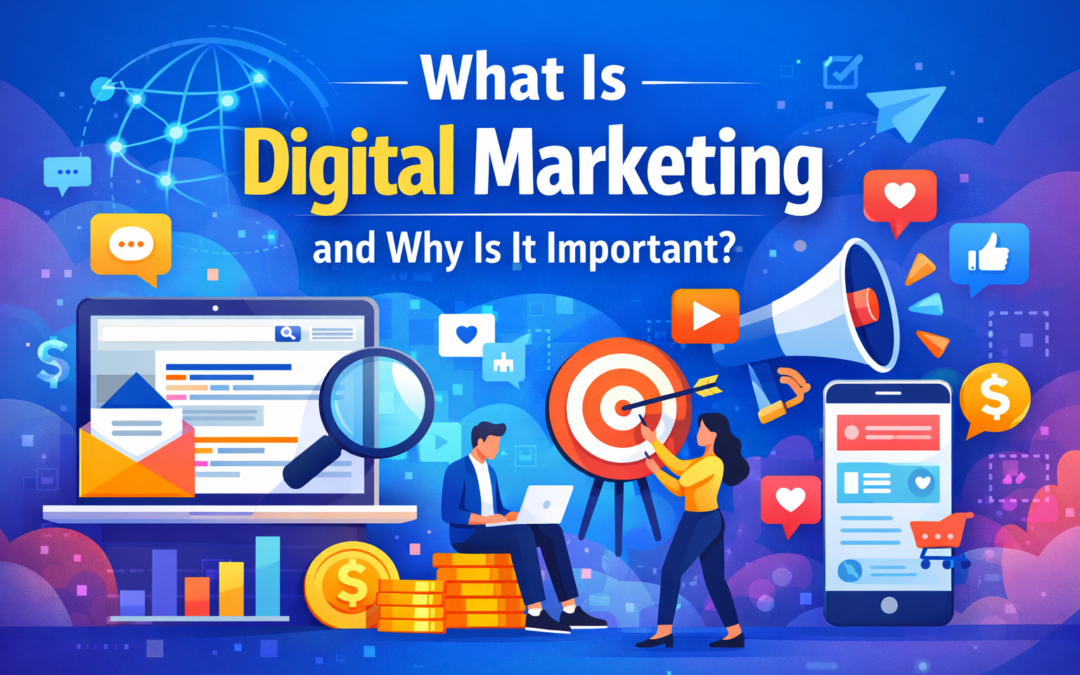
Quick Answer : Digital marketing is the practice of promoting products, services, or brands through online channels like search engines, social media, email, and websites. It is important because it helps businesses reach the right people at the right time, costs less than traditional advertising, and delivers results that can be tracked in real time. Whether you run a small shop or a large company, digital marketing gives you tools to grow your audience, build trust, and increase sales — all through the internet.
Contents
- 1 Table of Contents
- 2 What Is Digital Marketing?
- 3 A Brief History of Digital Marketing
- 4 How Digital Marketing Works
- 5 The Main Types of Digital Marketing
- 6 Why Digital Marketing Is Important for Businesses
- 6.1 1. Your Customers Are Online
- 6.2 2. It Costs Less Than Traditional Marketing
- 6.3 3. You Can Target the Right People
- 6.4 4. Results Are Measurable
- 6.5 5. It Builds Trust and Credibility
- 6.6 6. You Can Compete with Bigger Companies
- 6.7 7. Digital Marketing Works Around the Clock
- 6.8 8. You Can Personalize the Experience
- 7 Digital Marketing vs. Traditional Marketing
- 8 How Small Businesses Benefit from Digital Marketing
- 9 Key Digital Marketing Channels Explained
- 10 What Makes a Good Digital Marketing Strategy?
- 11 Common Digital Marketing Mistakes to Avoid
- 12 The Future of Digital Marketing
- 13 Digital Marketing Metrics You Should Know
- 14 How to Start with Digital Marketing Today
- 15 Frequently Asked Questions (FAQs)
- 15.1 What is digital marketing in simple words?
- 15.2 Why is digital marketing important for small businesses?
- 15.3 What is the difference between digital marketing and social media marketing?
- 15.4 How much does digital marketing cost?
- 15.5 How long does it take to see results from digital marketing?
- 15.6 What is SEO in digital marketing?
- 15.7 Is digital marketing better than traditional marketing?
- 15.8 What skills are needed for digital marketing?
- 15.9 Can digital marketing work for any type of business?
- 15.10 What is the most important part of digital marketing?
- 16 Conclusion
Table of Contents
- What Is Digital Marketing?
- A Brief History of Digital Marketing
- How Digital Marketing Works
- The Main Types of Digital Marketing
- Why Digital Marketing Is Important for Businesses
- Digital Marketing vs. Traditional Marketing
- How Small Businesses Benefit from Digital Marketing
- Key Digital Marketing Channels Explained
- What Makes a Good Digital Marketing Strategy?
- Common Digital Marketing Mistakes to Avoid
- The Future of Digital Marketing
- Frequently Asked Questions (FAQs)
What Is Digital Marketing?
Digital marketing means using the internet to promote a business or brand. It includes everything from posting on Instagram to running ads on Google, sending emails to customers, or writing blog posts that appear in search results.
Think of it this way. In the past, businesses advertised through TV commercials, newspaper ads, and billboards. Those methods still exist. But today, most people spend hours each day on their phones and computers. So businesses now go where the people are — online.
Digital marketing covers a wide range of activities:
- Creating a website that attracts visitors from search engines
- Running paid ads on platforms like Google or Facebook
- Sending email newsletters to customers
- Posting helpful content on social media
- Making videos that educate or entertain people
- Partnering with influencers who already have an audience
At its core, digital marketing is about connecting with people using digital tools. It is not just about selling. It is about starting conversations, building trust, and staying in someone’s mind so that when they are ready to buy, they think of you first.
The Simple Definition
If someone asks you, “What is digital marketing?” — here is a simple way to explain it:
Digital marketing is any kind of marketing that happens on a screen connected to the internet.
That screen could be a phone, a tablet, a laptop, or a smart TV. The internet is the delivery system. The message could be an ad, a video, a blog post, a tweet, or an email.
A Brief History of Digital Marketing
Digital marketing did not appear overnight. It grew slowly as the internet grew.
1990s — The Early Days The first clickable banner ad appeared in 1994 on a website called HotWired. It had a 44% click-through rate — something unheard of today. Email marketing also started in this decade, with businesses sending mass emails to large lists of subscribers.
Early 2000s — Search Engines Take Over Google launched in 1998 and changed everything. People started using search engines to find information. Businesses quickly realized that showing up on Google’s first page could bring them thousands of visitors for free. This gave rise to Search Engine Optimization (SEO).
2004–2010 — Social Media Arrives Facebook launched in 2004. YouTube started in 2005. Twitter came in 2006. Suddenly, businesses had new places to reach customers. Social media marketing was born.
2010–2020 — Mobile Changes Everything Smartphones became mainstream. More people started searching the web on their phones than on desktop computers. Google updated its algorithm to favor websites that worked well on mobile screens. Businesses had to adapt fast.
2020–Present — AI, Video, and Personalization Today, artificial intelligence helps marketers predict what customers want. Short-form video (like TikTok and Instagram Reels) dominates attention. Personalization is the standard — people expect ads and content that feel relevant to them specifically, not generic messages sent to everyone.
Digital marketing keeps evolving. What worked five years ago may not work as well today. But the goal has always stayed the same: reach the right person with the right message at the right time.
How Digital Marketing Works
Digital marketing works by using data to understand people — what they search for, what they click on, what they buy — and then showing them content or ads that match their needs.
Here is a basic example:
Say you sell running shoes. A person types “best running shoes for beginners” into Google. If you have written a helpful article about that topic, your website can appear in the search results. The person reads your article, trusts your advice, clicks to your product page, and buys a pair of shoes.
That entire journey — from the search to the sale — is digital marketing in action.
Another example: Someone visits your website but leaves without buying anything. A digital tool called a pixel tracks that visit. The next day, when they scroll through Facebook, they see an ad for the exact shoes they looked at. They click the ad and buy. That is called retargeting, and it is one of the most effective tools in digital marketing.
The Customer Journey in Digital Marketing
Digital marketing experts often talk about the “customer journey.” This describes the steps a person takes from first hearing about your brand to becoming a loyal customer. The journey typically has four stages:
Awareness — The person first learns your brand exists. This might happen through a Google search, a social media post, or an ad.
Consideration — The person starts comparing options. They read reviews, watch videos, and look at different products. Good content marketing and SEO help here.
Decision — The person is ready to buy. Clear product descriptions, good reviews, and an easy checkout process close the sale.
Loyalty — After the purchase, email marketing and good customer service bring them back for more.
Digital marketing works across all four of these stages.
The Main Types of Digital Marketing
Digital marketing is not one single thing. It is a collection of different methods and channels. Here are the main ones:
1. Search Engine Optimization (SEO)
SEO is the process of improving your website so it appears higher in search engine results pages (SERPs) like Google. When someone searches for a term related to your business, you want your site to show up near the top.
SEO involves writing useful content, using the right keywords, making your site load fast, and earning links from other websites. It takes time but delivers long-lasting results.
2. Search Engine Marketing (SEM) / Pay-Per-Click (PPC)
SEM means running paid ads on search engines. When you search on Google, you often see results labeled “Sponsored” at the top. Those are paid ads. Businesses pay every time someone clicks on their ad — this is called Pay-Per-Click advertising.
Google Ads is the biggest platform for this. SEM gives you immediate visibility while SEO takes time to build.
3. Content Marketing
Content marketing means creating valuable, helpful content — blog posts, videos, podcasts, infographics, guides — that attracts people to your brand. The idea is simple: help people with useful information, and they will trust you enough to buy from you.
This article you are reading right now is an example of content marketing.
4. Social Media Marketing
This involves using platforms like Facebook, Instagram, LinkedIn, Twitter (now X), TikTok, and Pinterest to promote your business. Social media marketing can be organic (posting without paying) or paid (running ads).
Social media is great for building a community, sharing your brand’s personality, and engaging directly with customers.
5. Email Marketing
Email marketing involves sending messages directly to people who have subscribed to your list. It is one of the oldest forms of digital marketing and still one of the most effective. For every dollar spent on email marketing, businesses earn an average of $36 back — one of the highest returns of any marketing channel.
Email marketing includes newsletters, promotional offers, product updates, and automated sequences that guide new subscribers toward a purchase.
6. Affiliate Marketing
Affiliate marketing works like a referral program. You partner with other websites or individuals (affiliates) who promote your product. When someone buys through their unique link, the affiliate earns a commission.
This is a win-win: you get sales, and your affiliate earns money for recommending your product.
7. Influencer Marketing
Influencer marketing means partnering with people who have large, engaged social media followings. Influencers recommend your product to their audience. Because their followers trust them, these recommendations can be very powerful.
Influencer marketing works across Instagram, YouTube, TikTok, and even podcasts.
8. Video Marketing
Video is one of the most consumed types of content online. YouTube is the second-largest search engine in the world. Platforms like TikTok and Instagram Reels have made short-form video the dominant format for reaching younger audiences.
Video marketing includes product demos, tutorials, behind-the-scenes content, testimonials, and live streams.
9. Display Advertising
Display ads are visual banner ads that appear on websites across the internet. When you read a news article and see an ad in the sidebar, that is display advertising. Google’s Display Network reaches over 90% of internet users worldwide.
10. Mobile Marketing
Mobile marketing specifically targets users on smartphones. This includes SMS text messages, push notifications from apps, mobile-optimized websites, and in-app advertising.
Since more than 60% of all internet traffic comes from mobile devices, mobile marketing is no longer optional — it is essential.
Why Digital Marketing Is Important for Businesses
This is the big question. Why should any business — big or small — invest time and money into digital marketing?
Here are the reasons, explained clearly.
1. Your Customers Are Online
This is the most important reason. According to global data, over 5.3 billion people use the internet. In many countries, more than 90% of the population has internet access.
Your customers are scrolling social media, watching YouTube, reading blogs, and searching Google every single day. If you are not visible online, you are invisible to most of them.
2. It Costs Less Than Traditional Marketing
Running a TV commercial can cost thousands of dollars. A full-page newspaper ad is expensive. A billboard in a busy city costs even more.
With digital marketing, you can start with a very small budget. You can run Facebook ads starting from a few dollars a day. You can start an email list for free. You can write blog posts yourself at no cost.
The barrier to entry is low. This means even small businesses can compete with larger ones if they use digital marketing smartly.
3. You Can Target the Right People
Traditional marketing is like shouting in a crowded room and hoping the right person hears you.
Digital marketing is like whispering directly into the ear of someone who is already interested in what you offer.
With tools like Facebook Ads Manager or Google Ads, you can target people based on their age, location, interests, search history, income level, and even the type of device they use. This precision targeting reduces wasted ad spend and improves results.
4. Results Are Measurable
When you put up a billboard, you cannot really know how many people saw it, how many called because of it, or what it returned on your investment.
Digital marketing is different. Every click, every view, every email open, and every purchase can be tracked. You know exactly which ad drove a sale, which blog post brought the most visitors, and which email subject line got the most opens.
This data lets you make smarter decisions and continually improve your marketing.
5. It Builds Trust and Credibility
When someone searches for your business online and finds a well-designed website, helpful blog posts, positive reviews, and active social media accounts — they trust you more.
Good digital marketing builds your brand’s reputation. It positions you as an authority in your field. This trust is what turns strangers into customers and customers into loyal fans.
6. You Can Compete with Bigger Companies
Before digital marketing, a small local shop had almost no way to compete with a national chain’s advertising budget.
Today, a well-crafted SEO strategy, a strong social media presence, and a smart email campaign can help a small business outperform a large competitor online. The playing field is not perfectly level, but it is much more even than it used to be.
7. Digital Marketing Works Around the Clock
Your website is open 24 hours a day, 7 days a week. A blog post you wrote two years ago can still bring visitors today. An email campaign can be scheduled to send at 3 AM while you sleep.
Digital marketing does not clock out. It keeps working for your business continuously.
8. You Can Personalize the Experience
Digital marketing lets you tailor your message to each customer. You can send one email to first-time visitors and a different email to loyal customers. You can show different ads to people in different cities. You can recommend products based on what someone previously bought.
Personalization makes people feel seen and understood. It increases engagement and drives more sales.
Digital Marketing vs. Traditional Marketing
Both digital marketing and traditional marketing have their place. But understanding the differences helps you make better decisions about where to invest.
Reach: Traditional marketing (TV, radio, print) can reach a mass audience quickly. Digital marketing can reach global audiences at a lower cost, with better targeting.
Cost: Traditional marketing is generally more expensive. Digital marketing offers more flexible budgets.
Measurement: Traditional marketing results are hard to measure. Digital marketing provides detailed analytics.
Interaction: Traditional marketing is one-way communication. Digital marketing allows two-way interaction — customers can comment, share, reply, and review.
Speed: Printing a brochure or filming a commercial takes time. A digital campaign can launch in hours.
Flexibility: Traditional campaigns are hard to change once published. Digital campaigns can be adjusted in real time.
For most businesses, a combination of both works best. But as more people move online, the weight of investment is shifting heavily toward digital.
How Small Businesses Benefit from Digital Marketing
Small businesses often think digital marketing is only for big companies with large budgets. That is not true. In fact, small businesses often benefit the most.
Local SEO Helps You Get Found Nearby
If you run a restaurant, salon, or repair shop, Local SEO helps you appear when someone nearby searches for your service. When someone types “pizza near me” or “plumber in [city],” a properly optimized Google Business Profile can put your business at the very top of the results.
This is free visibility that can bring real, paying customers through your door.
Social Media Builds Community
Small businesses can use social media to build a loyal community around their brand. Sharing behind-the-scenes content, responding to comments, and celebrating customers creates genuine connections that large companies often struggle to replicate.
Email Marketing Drives Repeat Business
For a small business, keeping existing customers is often more valuable than finding new ones. Email marketing is a cost-effective way to stay in touch, share promotions, and bring customers back.
Content Marketing Builds Authority
A small business that consistently writes helpful blog posts or creates useful videos can establish itself as the go-to expert in its niche — even outranking much larger competitors in search results.
Key Digital Marketing Channels Explained
Let us take a closer look at the most important channels and how they work in practice.
Google Search (SEO and PPC)
Google processes over 8.5 billion searches every day. Ranking on the first page for a relevant keyword can send a steady stream of visitors to your website.
SEO focuses on earning these rankings organically through great content and technical website improvements. PPC lets you buy your way to the top instantly through Google Ads.
The best strategy uses both — SEO for long-term, sustainable traffic and PPC for immediate results.
Facebook and Instagram
Meta’s platforms (Facebook and Instagram) have over 3 billion monthly active users combined. They offer some of the most advanced targeting tools in digital advertising.
You can run image ads, video ads, carousel ads, and story ads. You can target by age, location, interests, behaviors, and even custom audiences built from your existing customer list.
Organic posting on these platforms has declined in reach over the years, which is why paid advertising has become more important.
YouTube
YouTube has over 2.7 billion logged-in users monthly. It is not just entertainment — people use YouTube to learn, compare products, and make buying decisions.
A well-produced product review video or tutorial can drive significant traffic and conversions. YouTube SEO (optimizing video titles, descriptions, and tags) helps your videos get found.
LinkedIn is the premier professional network. For B2B (business-to-business) companies, it is invaluable. You can connect with decision-makers, share industry insights, and run ads targeted to specific job titles, industries, and company sizes.
TikTok
TikTok has grown rapidly into one of the most-used social media platforms, particularly among younger audiences. Its algorithm favors entertaining, authentic content over polished production. Brands that create genuinely interesting videos can achieve massive organic reach.
Despite being one of the oldest digital channels, email remains one of the most powerful. People who subscribe to your list have actively chosen to hear from you — that intention makes them highly valuable.
Email platforms like Mailchimp, Klaviyo, and ConvertKit make it easy to segment your list, automate campaigns, and track performance.
What Makes a Good Digital Marketing Strategy?
A strategy is the plan that ties all your digital marketing activities together. Without one, you are just guessing.
Here is what a good digital marketing strategy includes:
Clear Goals
What do you want to achieve? More website visitors? More email subscribers? More sales? More brand awareness? Your goals shape every decision you make.
Goals should be specific and measurable. “I want to grow my email list from 500 to 2,000 subscribers in six months” is a good goal. “I want to get more customers” is too vague.
Know Your Audience
Good digital marketing starts with deep knowledge of your customer. Who are they? What problems do they have? What do they search for? Where do they spend time online?
Creating detailed customer personas helps you create content and ads that speak directly to real people’s needs.
Choose the Right Channels
You do not need to be everywhere. Trying to master every platform at once leads to burnout and poor results.
Pick two or three channels where your audience is most active and focus your energy there. A B2B software company might focus on LinkedIn and SEO. A fashion brand might focus on Instagram and TikTok.
Create Valuable Content
Whatever channels you use, content is the engine. Content includes blog posts, videos, social media captions, email newsletters, and ad copy.
Great content answers real questions, solves real problems, and reflects your brand’s personality. It is not just about selling — it is about being genuinely useful.
Analyze and Improve
Set up tracking tools like Google Analytics, Meta Pixel, and email open rate tracking. Review your data regularly. What is working? What is not? Digital marketing is never “set and forget” — it requires constant learning and improvement.
Common Digital Marketing Mistakes to Avoid
Even experienced marketers make mistakes. Knowing the most common ones helps you avoid them.
Trying to Be Everywhere at Once Spreading yourself across every platform without focus leads to poor results on all of them. Choose your channels wisely based on where your audience actually is.
Ignoring Mobile Users If your website is not optimized for mobile devices, you are losing a large percentage of your potential audience. Google also ranks mobile-friendly sites higher.
Neglecting SEO Many businesses focus only on paid ads and ignore organic search. SEO takes time but delivers compounding results. A blog post that ranks on page one can bring traffic for years.
Not Having a Clear Call to Action Every piece of content should tell the reader what to do next. Buy now. Subscribe here. Download this guide. Without a clear call to action, people leave without engaging further.
Ignoring Analytics Making decisions without data is guesswork. You need to know which campaigns are working, which pages are getting traffic, and where people are dropping off.
Inconsistent Branding Your brand should look and sound the same across all channels. Inconsistent colors, tone, or messaging confuses people and weakens your brand.
Giving Up Too Soon SEO takes months to show results. Email lists take time to grow. Social media audiences build slowly. Many businesses quit before they see results. Patience and consistency are essential.
The Future of Digital Marketing
Digital marketing will continue to evolve. Here are the biggest trends shaping its future:
Artificial Intelligence (AI)
AI is already transforming digital marketing. Tools powered by AI can write ad copy, generate images, personalize email content, predict which customers are likely to buy, and analyze data far faster than any human team. AI is not replacing marketers — it is making them more powerful.
Voice Search
More people use voice assistants like Siri, Alexa, and Google Assistant to search the internet. Voice searches tend to be longer and more conversational than typed searches. Optimizing content for voice search means using natural language and directly answering common questions — like this article does.
Short-Form Video
Short-form video content (under 60 seconds) has exploded in popularity. Platforms like TikTok, Instagram Reels, and YouTube Shorts are where attention is migrating. Brands that master short, engaging video content will have a significant advantage.
Personalization at Scale
Customers expect personalized experiences. Using data and AI, businesses can deliver individualized messages, product recommendations, and website experiences to each visitor. Generic, one-size-fits-all marketing is becoming less effective.
Privacy and First-Party Data
Growing concerns about privacy have led to major changes in digital advertising. Third-party cookies (which tracked users across websites) are being phased out. This means businesses must build their own customer data through email lists, loyalty programs, and direct relationships.
Social Commerce
Shopping directly within social media apps — without leaving to visit a separate website — is becoming more common. Instagram, TikTok, and Pinterest all offer in-app shopping features. This reduces friction in the buying process and boosts conversions.
Sustainability and Ethical Marketing
Consumers are increasingly choosing brands that align with their values. Businesses that are transparent about their environmental impact, fair labor practices, and social responsibility are building stronger loyalty — especially among younger consumers.
Digital Marketing Metrics You Should Know
To measure success in digital marketing, you need to understand the key metrics:
Traffic — The number of visitors coming to your website. Measured by tools like Google Analytics.
Conversion Rate — The percentage of visitors who complete a desired action (buying, signing up, downloading). A 2–5% conversion rate is typical for e-commerce.
Click-Through Rate (CTR) — The percentage of people who saw your ad or email and clicked on it.
Cost Per Click (CPC) — How much you pay each time someone clicks on a paid ad.
Return on Ad Spend (ROAS) — How much revenue you earn for every dollar spent on advertising.
Customer Acquisition Cost (CAC) — The total cost of acquiring one new customer.
Customer Lifetime Value (CLV) — The total amount of money a customer spends with your business over their entire relationship with you.
Bounce Rate — The percentage of visitors who leave your website after viewing just one page.
Email Open Rate — The percentage of email subscribers who open your emails. A 20–25% open rate is considered good for most industries.
Social Media Engagement Rate — Likes, comments, shares, and saves divided by total followers. Shows how actively your audience interacts with your content.
Understanding these numbers tells you what is working and where to focus your effort.
How to Start with Digital Marketing Today
You do not need a big budget or a marketing degree to start. Here is a simple path:
Step 1: Build a website. Your website is your digital home base. Make sure it is fast, mobile-friendly, and clearly explains what you offer. Use platforms like WordPress, Squarespace, or Shopify.
Step 2: Set up a Google Business Profile. This is free and helps you appear in local search results and Google Maps. Fill out every section of your profile completely.
Step 3: Start an email list. Use a free tool like Mailchimp to collect email addresses from your customers and website visitors. Send helpful, consistent emails.
Step 4: Create content. Start a blog or YouTube channel. Answer the questions your customers ask most often. Post consistently — quality matters more than quantity.
Step 5: Pick one social media platform. Choose the platform where your audience is most active. Post regularly. Engage with comments. Build community before chasing follower counts.
Step 6: Learn from data. Install Google Analytics on your website. Track which pages get the most traffic. See where visitors come from. Let the data guide your decisions.
Step 7: Test paid ads carefully. Once you have the basics in place, experiment with small paid ad budgets. Test different audiences and messages. Scale what works.
Digital marketing is a skill that improves with practice. Start small, stay consistent, and keep learning.
Frequently Asked Questions (FAQs)
What is digital marketing in simple words?
Digital marketing is the use of the internet and online tools to promote a business. This includes websites, social media, email, search engines, and online ads. It helps businesses reach people where they already spend time — on their phones and computers.
Why is digital marketing important for small businesses?
Digital marketing levels the playing field for small businesses. It is more affordable than traditional advertising, allows precise targeting of the right audience, and delivers measurable results. Small businesses can use SEO, social media, and email marketing to compete effectively even against much larger companies.
Social media marketing is one part of digital marketing. Digital marketing is the broader term that includes SEO, email marketing, paid advertising, content marketing, video marketing, and more. Social media marketing specifically refers to using platforms like Facebook, Instagram, TikTok, and LinkedIn to promote a business.
How much does digital marketing cost?
The cost varies widely. You can start a blog, email list, and social media presence for little to no money. Paid advertising can start for a few dollars per day. A comprehensive digital marketing strategy for a growing business might cost $1,000–$10,000 per month in agency fees or ad spend. The budget depends on your goals, industry, and chosen channels.
How long does it take to see results from digital marketing?
It depends on the method. Paid ads can bring results immediately. SEO typically takes 3–6 months to show significant results. Email marketing and content marketing build over time. Most experts recommend committing to digital marketing for at least 6–12 months before evaluating its full impact.
What is SEO in digital marketing?
SEO stands for Search Engine Optimization. It is the process of improving your website and content so that search engines like Google rank you higher in search results. Higher rankings mean more people find you when they search for topics related to your business.
Is digital marketing better than traditional marketing?
Neither is universally better — it depends on your audience, goals, and budget. Digital marketing is generally more cost-effective, measurable, and targeted. Traditional marketing can reach broad audiences quickly. Most successful businesses use a combination of both, though investment is increasingly shifting toward digital.
What skills are needed for digital marketing?
Key skills include writing and content creation, SEO knowledge, data analysis, social media management, email marketing, basic graphic design, and an understanding of paid advertising platforms. Curiosity, adaptability, and a willingness to keep learning are also essential, since digital marketing changes constantly.
Can digital marketing work for any type of business?
Yes. Digital marketing works for B2B companies, B2C retailers, service providers, nonprofits, freelancers, and local businesses of all kinds. The strategy and channels will differ, but the core principles — reach the right people with a helpful message through online channels — apply universally.
What is the most important part of digital marketing?
Many experts would say the most important element is understanding your customer. All the tools and tactics in digital marketing only work if you know who you are trying to reach, what problems they have, and what messages will resonate with them. Strategy and customer insight drive results. Tools just execute the strategy.
Conclusion
Digital marketing is not a trend or a nice-to-have option for businesses today. It is a fundamental part of how companies grow, compete, and survive in a world where people live increasingly online.
Understanding what digital marketing is — and why it matters — is the first step. The next step is taking action: building your web presence, creating content that helps people, learning from the data you collect, and staying consistent even when results take time.
Whether you are a student curious about marketing careers, a small business owner looking for growth, or an experienced professional wanting to sharpen your skills, digital marketing offers tools and opportunities that were impossible just a generation ago.
The businesses that thrive in the coming decades will be the ones that embrace this shift — and learn to use these tools with purpose, creativity, and a genuine desire to help their customers.
Mahak Mittal is a digital marketing enthusiast who creates simple, practical content to help beginners understand online marketing and grow their skills. She shares insights on SEO, social media, and content strategies to help businesses and learners succeed in the digital world.